Lab culture
How we work
This page summarises how the SEM lab runs: our meetings, our mentoring, what we expect and what we provide. It is a condensed version of our lab handbook, which we are happy to send in full to prospective lab members.
Our values
The group agreed these collectively in October 2024.
Respect
Everyone recruited to the lab has outstanding scientific skills. Experience in a given field varies, and those with less of it often bring the perspective that unlocks a problem, so we value questions and opinions from everyone. Our feedback is constructive and always directed at the work, not individuals.
Trust and honesty
We hold to the highest standards of integrity and reproducibility, and we are honest with each other, and with ourselves, about our data. We share advice, code and data freely, within the lab and beyond.
Curiosity and creativity
We make time to follow up curiosities, anomalies and out-of-the-box ideas alongside long-term project goals. These often form future full projects of their own.
Humility and confidence
We all make mistakes and learn from one another, while being confident in our ability to generate outstanding scientific work.
One-to-ones
All first year PhD students and most lab members meet Alex weekly for 30 minutes to 1 hour. Postdocs and other members agree their own schedule, anywhere from weekly to ad hoc. Extra meetings are always available when something needs unblocking.
We use OneNote lab books to record discussion points and action items for lab members and Alex for each meeting.
Meetings
- Lab meeting, Wednesdays 14:30–16:00, with snacks bought by last week’s presenter. These rotate between scientific project updates, journal clubs, brainstorming sessions, method workshops, a “state of the lab” update from Alex, introductory talks from new members, and practice runs for external presentations.
- Neighbouring groups. We are welcome at, and regularly attend, the relevant lab meetings of the Blundell/Watson, Fitzgerald and Swanton groups.
- Monday stand-up, 09:00, 10–15 minutes, everyone, including anyone working from home that day (see below).
Brainstorming sessions, a few times a year, run on a whiteboard rather than slides. Everyone brings one idea (anything loosely related to the lab’s work, at any stage of readiness) and the group works through it together. Half-formed or slightly wild ideas are exactly the point; some of our grant proposals started out this way.
Project updates are deliberately unpolished and roughly half discussion. Negative results and dead ends are presented too. We ask everyone, however junior, to ask questions.
Moving between computational and experimental work
We recruit from biology, mathematics, physics, statistics, computer science and medicine, and from clinical training pathways, and many of our projects rely on both computational and experimental methods.
We don’t expect lab members to necessarily arrive fluent in both computational and experimental methods, and we commit to providing the training a project needs, computational or experimental. This includes University courses such as the Cambridge Bioinformatics Training programme and Nextflow training, plus hands-on bench training for specific techniques.
Nobody is expected to stay in the lane they arrived in.
Alex Frankell
Additionally the lab runs internal method workshops, where one person takes the whole group step by step through the guts of a method (e.g. duplex DNA library preparation, Nanopore sequencing, spatial genomics, haplotype phasing or allele-specific copy number determination) until everyone understands it. We keep a curated list of foundational papers for the field, and run code review every two months (below), to promote the sharing of coding skills and tips.
Project plans are not fixed at the outset. If there’s a skill you want to build (a technique, a language, a type of analysis), say so at a one-to-one and we will look at shaping your project to include it.
Code, data and reproducibility
We write clean, commented, reproducible code from the start rather than tidying it up in a panic before submission: messy code hides errors, and by the time a reviewer finds one it is too late. Nextflow is our preferred pipelining language, everything lives in git, and GitHub Copilot is available free through the University.
Every member puts one script through code review at least every two months: its main purpose is spreading tips and good habits around the lab, not just catching bugs. The author raises a pull request, the assigned reviewer comments, and then the two meet so the author can walk the reviewer through the code line by line (the rubber-duck method), with the reviewer chipping in with questions and alternative approaches they might have used. It’s one of the best ways to pick up new tricks as a coder, and most people here have learned something from it this way. (Before any paper is submitted, someone who did not write the code separately reproduces every figure from scratch.) Code and processed data are then deposited publicly.
Hours and flexibility
We know flexible working provides many benefits, from supporting wellbeing to accommodating caring responsibilities, and we try to build it into how the lab runs. Computational work can be done at home on Mondays, with the rest of the week (Tuesday to Friday) spent in the Early Cancer Institute; we stay in sync with a short 09:00 stand-up on Mondays for anyone working remotely that day. In-person time matters for the rest of the week: most of the good ideas here start at someone’s desk, not on a call. Experimental work is necessarily on site, with the occasional admin day at home.
We ask that you are working and contactable between 10:00 and 16:00, with flexibility either side to fit your working pattern; some people work around childcare on exactly this basis. If you need more flexibility than this, talk to Alex.
Total hours are set by your contract, or by the University’s Code of Practice for Research if you’re a student. Often people choose to put in more, to reach a specific goal (a fellowship application, a paper, or a strong case for their next position); how much extra, if any, is up to you.
What we provide
- Kit. A MacBook, docker hub, peripherals and two monitors for every member.
- Compute and storage. Access to the Cambridge CSD3 HPC and 250 TB of shared storage for research data. Where a project needs it, we arrange access to the TRACERx data on the Crick and UCL clusters.
- Software. Subscription to Claude and Claude Code via our Team account (used across the lab for automating routine tasks, speeding up coding, and literature synthesis and discovery), and various other subscriptions (BioRender, Illustrator, Paperpile etc).
- Conferences. We attend local meetings (Cambridge/London) regularly, plus one to three national or international conferences a year. Larger meetings such as AACR come later, once a project is mature enough. Costs are covered by the lab where bursaries do not, and we generally favour the 100–500 person meetings where you actually get talked to and all attendees will see your presentation. Meetings we particularly like include CNAPS, AACR Cancer Evolution, EACR Cancer Genomics, GRC Single-Cell Genomics, EACR Liquid Biopsies, Mutations in Time and Space, and The Many Faces of Cancer Evolution, among others.
- A route into the field. We sit in the Early Cancer Institute and the CRUK Cambridge Centre on the Cambridge Biomedical Campus, and we work closely with the Fitzgerald and Swanton groups. You will meet the people whose papers you are reading.
- Career support. Beyond one-to-ones, the University’s Postdoc Academy and Careers Service are excellent resources.
- A say in how the lab runs. Lab roles (social secretary, data manager, sustainability lead, website) rotate annually, and the “state of the lab” meetings exist partly so you can tell Alex what needs to change.
We hold LEAF sustainability accreditation and take the environmental cost of both wet and dry work seriously.
And the rest
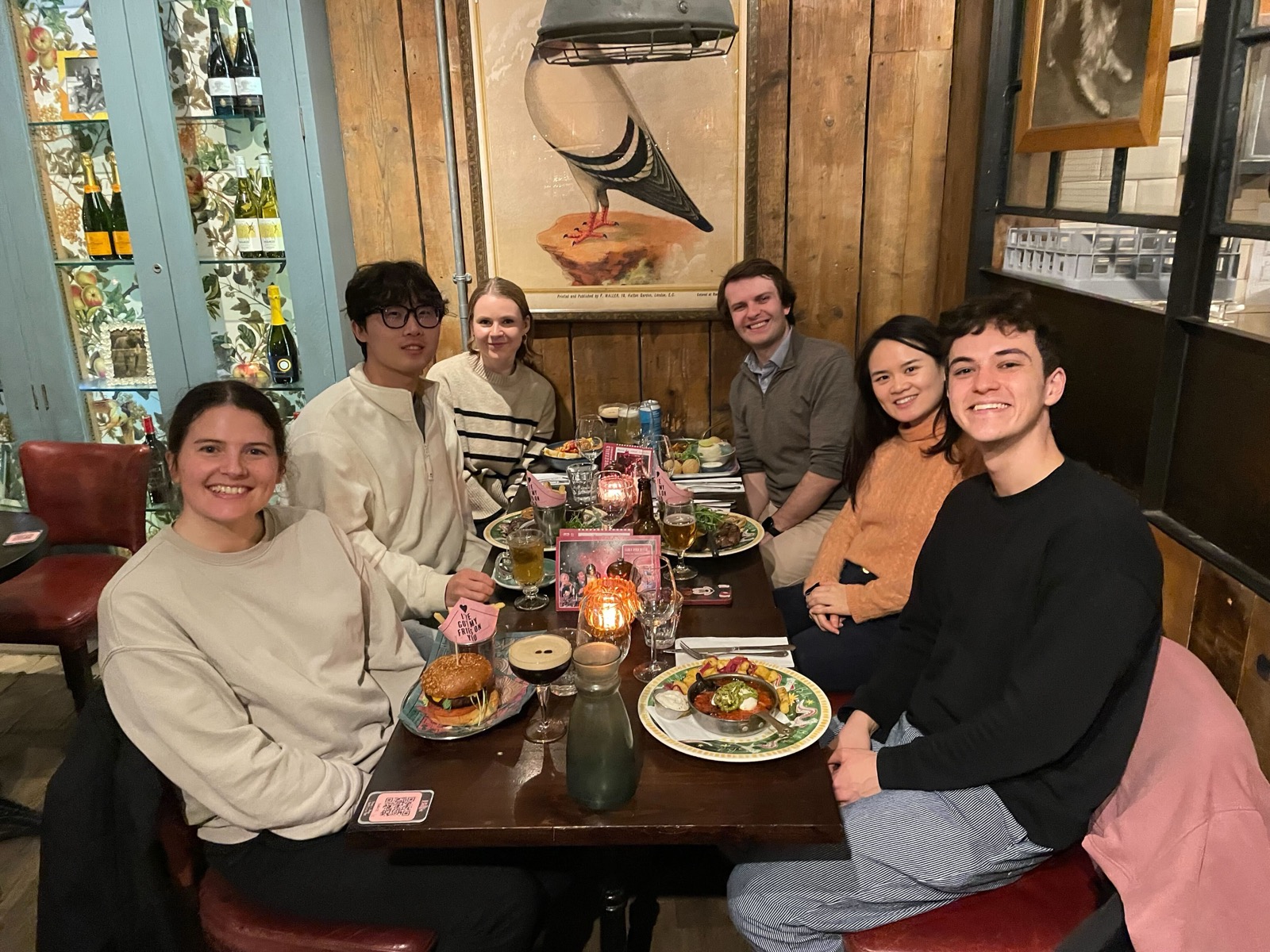
We eat cake on birthdays, go for drinks regularly (often to celebrate a paper, a fellowship or someone’s results finally working), and go out for a meal together at Christmas. Lab meeting talks open with a photo of something from your life outside the lab.
If this sounds like somewhere you could do your best work, see Opportunities, and do ask us for the full handbook.